Travelling At Night Skill checks without combat
Dialogue rolls, preparation, and redirecting failure in Antibes
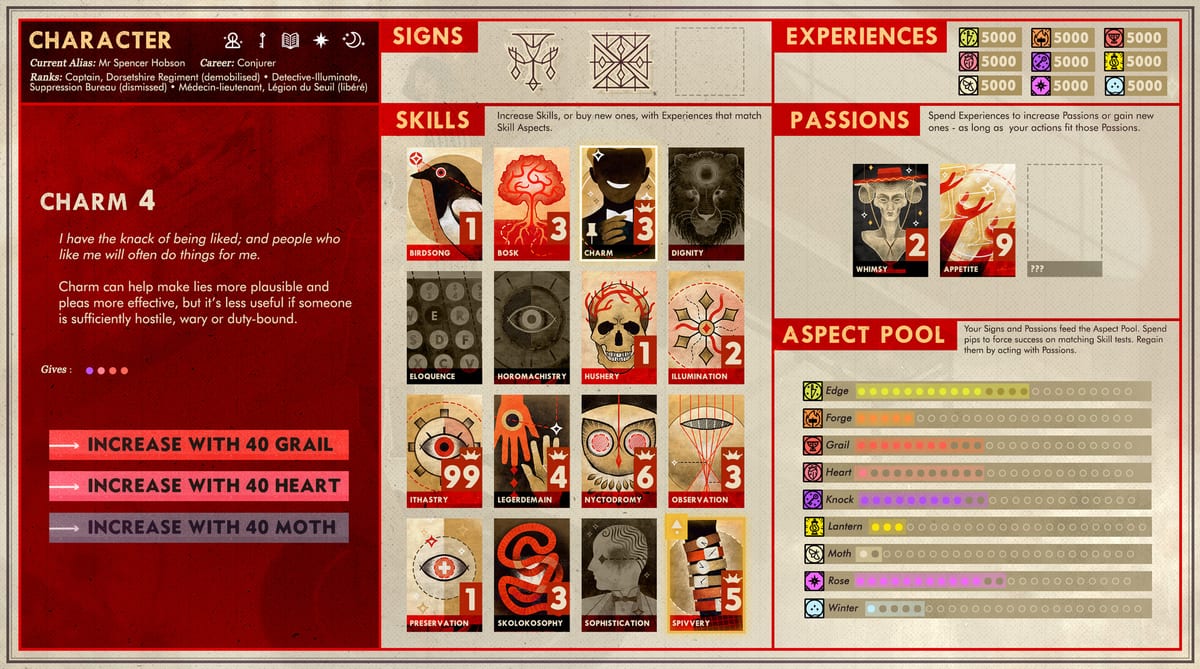
Travelling At Night has no combat loop, but it has plenty of skill checks. A check compares your invested skills—Dignity, Charm, Edge, occult specialties, and the rest of the sixteen—to a difficulty shaped by scene, attitude, meters, outfits, and companion aid. Understanding checks turns “RNG hate” into prep homework. This page complements How to play with check-specific literacy.
What a check is
When dialogue or action demands proof of Spencer’s capacity, the game sets a difficulty. Your relevant skill points meet that threshold with variance. Success opens branches, crafts, or calmer meters. Failure usually redirects—new dialogue, locked crafts, higher Dread—rather than game-over combat. Softlocks are rare in polished demo reports; prep gaps are common.
Difficulty ingredients
Environment matters: institutional halls read Respectable Aspects; cafés read Charm and Trace; church thresholds read occult skills. NPC attitudes stack. Dread silently raises difficulties across the board—see Dread & Trace. Trace changes who watches and how forgiving failure looks. Outfits modify Aspects before you speak—Outfits.
Temporary spends versus growth
You can sometimes spend experience for a short bonus to pass a critical beat. That is a legitimate tool for Nenah gates or sanitarium interviews. Spamming spends starves long-term growth from Memories & Signs. A good rule: one emergency spend per session, logged in the Build Planner.
Companion modifiers
Vincent aids rolls when recruited—Recruit Vincent. Treat companions as probability and texture, not autopilot wins. A high Charm Spencer with Vincent still fails Respectable gates in wrong coats.
Career and Passion bias
Exorcists notice holy checks; Writers notice Sophistication intel; Physicians notice clinical Dignity; Conjurers notice Edge and thin-place oddities—Careers, Passions. Bias is not lockout. Run two exists partly to prove other skills matter—Replay guide.
Failure etiquette
Failed checks are story. Before reloading, ask: wrong outfit? Dread spike? missing craft tool? wrong skill investment? Walk one landmark cluster, swap coat, craft one rite, talk to someone new. Beginner mistakes lists the classic misreads.
Check prep checklist
Before a hard scene: meter glance → outfit swap → confirm skill ranks → optional craft → companion present? → accept that failure may still redirect interestingly. This checklist beats forum superstition.
Relation to Footnotes
Footnotes interpret Memories into personality growth—Footnotes. They rarely replace skill points directly, but they change which checks you seek and which failures you accept. Appetite-heavy Footnotes invite different Charm risks than Compassion-heavy ones.
Demo versus full game
Check grammar stays stable while locations multiply. Learn it in Antibes so Hush House and eastern routes feel like new classrooms, not new games—Full-game locations.
Practice drills
Drill one: café Charm with Trace awareness. Drill two: sanitarium Dignity with Respectable kit. Drill three: church craft-gated talk with Exorcist or Writer. Log outcomes. Checks stop feeling opaque after three labelled failures.
When checks feel unfair
Verify demo patch notes—UI polish continues—Demo status. Verify you are not waiting for combat to solve social gates. Verify Linux/Mac build flags if buttons misbehave—Linux demo, Platforms.
Skill checks are the CRPG’s heartbeat. Dress for them. Craft for them. Manage meters for them. Then let Spencer speak.
Linux and storefront parity
Checks behave the same on native Linux builds when installed from Steam—see Linux demo. If input feels wrong, verify desktop environment shortcuts before blaming difficulty math.
Anchor links for teachers
Send newcomers: How to play → this page → Manage Dread → Craft items. Send veterans: Replay guide → tier lists. Checks sit in the middle of the verb chain on purpose.
Frequently Asked Questions
Quick answers drawn from the demo and official notes.
Is there a combat check?
No. Checks are social, occult, and institutional—combat remains absent by design.
Does high Dread make all checks harder?
Yes—Dread acts as a silent difficulty tax until you manage it down.
Can I pass every check?
No—and you should not try. Redirects are narrative content.
Where do skill points come from?
Memories and Signs invested into the sixteen skills—see Memories & Signs and Skills pages.